Stripe Sessions 2026 Made Agent Payments Real. Merchants Still Need to Be Readable.
Stripe Sessions 2026 gave merchants a concrete payments signal: AI agents now need buying infrastructure, not recommendation surfaces alone.
Stripe framed Sessions 2026 around "economic infrastructure for AI" and announced 288 new products and features. In the public keynote, Patrick Collison said agents will account for most transactions online in the not-too-distant future. Will Gaybrick described agents as autonomous economic actors.
Agents will browse stores, compare products, request payment authority, use scoped credentials, complete transactions, and come back as repeat customers.
This puts Stripe agentic commerce on the merchant roadmap.
What Stripe expanded at Sessions 2026
Stripe did not launch the Agentic Commerce Suite for the first time at Sessions 2026. It launched the suite last year. What changed this year is the scope.
Stripe said the Agentic Commerce Suite lets businesses sell products inside AI apps through a single integration. Kate Spade, Best Buy, and Coach are already building with it. Stripe also announced deeper distribution into major consumer surfaces, including a partnership with Google so customers can buy inside AI Mode and Gemini, plus native checkout inside Facebook ads through Meta. (Stripe)
Agentic commerce now spans search, AI assistants, ads, social surfaces, and embedded checkout flows.
Stripe's Sessions recap also matters for platform merchants. Stripe said it is bringing Agentic Commerce Suite support to platforms so businesses on Wix, BigCommerce, WooCommerce, and more can sell inside AI apps. Merchants can upload product catalogs and manage agent access from the Stripe Dashboard. Platforms will be able to make connected accounts agent-ready with discovery, checkout, payments, and fraud detection through one integration.
For Shopify merchants, Stripe's keynote also pointed to Shopify Catalog as preferred catalog infrastructure for retailers integrating with the suite. The reason is practical: agents need structured data, clean attributes, and real-time product accuracy before they can make a good buying decision.
Stripe AI agent payments, in plain English
The payment layer has four pieces merchants should understand.
First, Link's wallet for agents gives consumers a way to let agents pay without handing over raw card details. An agent can request a one-time-use card or a Shared Payment Token backed by the cards and bank accounts already in Link. The consumer reviews and approves spend requests in Link on web, iOS, or Android.
For consumers, Link closes the gap between "my agent found something" and "my agent can safely buy this with my approval."
Second, Issuing for agents gives businesses and agentic platforms programmable spending infrastructure. Developers can create single-use virtual cards, set spend limits, apply merchant category controls, freeze cards, monitor usage, and keep agents inside policy guardrails. Virtual cards matter because most of today's internet was not built for machine-native payment protocols. They let agents transact with existing merchants while the rest of the stack catches up.
Third, Shared Payment Tokens are the machine-native credential layer. An SPT is a scoped grant to use a customer's payment method. It can include seller scope, maximum amount, currency, and expiration limits. The seller uses the token to create a PaymentIntent, and Stripe completes the transaction without exposing full payment credentials.
The abstraction is permission, not card sharing. The question is not simply whether an agent can pay. The question is whether a user can delegate a specific payment safely.
Fourth, the Machine Payments Protocol brings payment into the request itself. Stripe's agentic commerce docs distinguish selling through agents from accepting machine payments. UCP and ACP help with commerce through agents. MPP and x402 help with machine-to-machine payment flows, including APIs, services, recurring payments, and pay-per-request models.
For most ecommerce merchants, MPP may feel less urgent than product catalog readiness. The direction is consistent: agents are becoming buyers and payers, not traffic sources alone.
Checkout is not the starting line
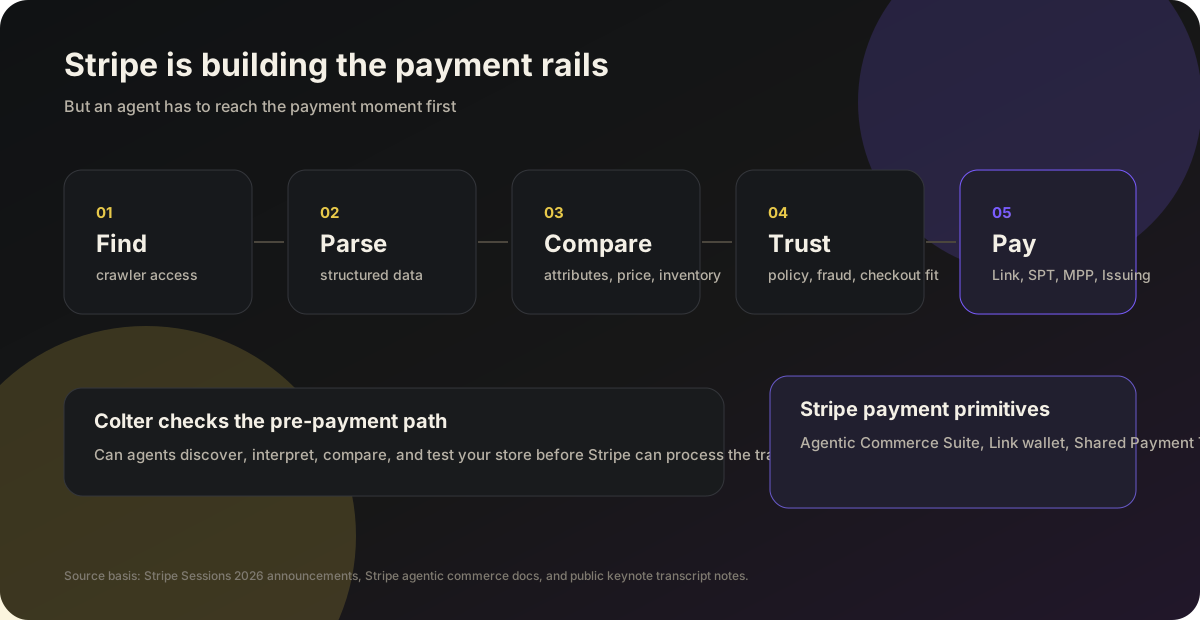
Stripe is building the payment rails. That does not mean every store is ready to receive agent demand.
Agent payments are the last step in a chain. Before an agent can pay for your product, it needs to find your product, understand your product, compare your product, decide your product is the right choice, and trust that the merchant can fulfill the order.
Stripe's own Sessions programming reinforces this. The agentic commerce under the hood session described production challenges such as making catalogs legible to agents, embedding customer context, and re-architecting fraud and pricing models. The Beyond checkout session said the structural shift begins earlier, with product discovery, evaluation, and agents acting on behalf of consumers. The agentic payments session focused on authorization models, agent authentication, merchant APIs, and fraud detection.
Merchant readiness sits in that pre-payment chain.
Stripe can help an agent pay. It cannot make an agent choose a product it cannot read.
What this changes for merchants
Merchant teams should check five surfaces.
Your product data needs to be complete enough for an agent to compare. That means clean titles, variants, pricing, availability, shipping rules, return policies, sizing, compatibility, ingredients, warranty terms, and product identifiers where relevant.
Your site needs to be accessible to AI crawlers and agentic browsers. Robots rules, JavaScript-heavy rendering, blocked resources, thin category pages, and missing structured data can all make a store harder for agents to parse.
Your product pages need enough decision context. Agents do not shop like humans. They look for explicit facts, constraints, policies, and proof. "Premium quality" does not help. Exact material, use case, dimensions, fit, delivery estimate, and refund policy do.
Your analytics need to separate human traffic from agent traffic. As agents begin to research, compare, and transact, merchants will need to know when AI systems are reading catalog pages, calling product feeds, or testing checkout flows.
Your checkout path needs to be tested by agents as well as humans. A payment rail only helps when the agent can reach the payment moment.
Stripe also reminded merchants that conversion infrastructure still matters. In the keynote, Stripe said Link drives a 5% lift in conversion for returning customers, and businesses using Stripe Checkout grew revenue two times faster on average. Those are not agent-specific guarantees for every merchant. They are reminders that payment UX compounds once discovery starts shifting.
A secondary attendee write-up from Gao Fei made the same practical point from the floor at Stripe Sessions. Gao reported Jeff Weinstein's merchant-readiness advice this way: agents want complete information, structured formats, fast readability, logistics detail, and the ability to transact in as few steps as possible. Gao also reported that agent traffic reading Stripe documentation grew roughly tenfold in 2025, a useful signal that agents are already becoming economic readers as well as economic actors. (Gao Fei)
Colter's view: readiness comes before payment
Colter is the independent QA layer for agentic commerce.
Stripe is building the rails that let agents pay. Colter checks whether your store can reach that payment moment in the first place.
Colter Check scans whether agents can discover, parse, and understand your store. Colter Fix generates prioritized remediation, so your team knows what to change first. Colter Lens tracks observed agent traffic and readiness over time. Colter Test runs managed AI shopping journeys against your store, so you can see where supported agent workflows succeed, fail, or need better storefront tooling.
For Shopify, WooCommerce, BigCommerce, Wix, and custom ecommerce teams, the question after Stripe Sessions 2026 is not "Should we care about agents?"
The operating question is: can an agent understand enough about your store to choose you?
Run a free agent readiness check at agenticcom.ai/check.