Shopify Just Put Numbers on Agentic Commerce
Shopify's Q1 2026 earnings call put numbers on AI shopping.
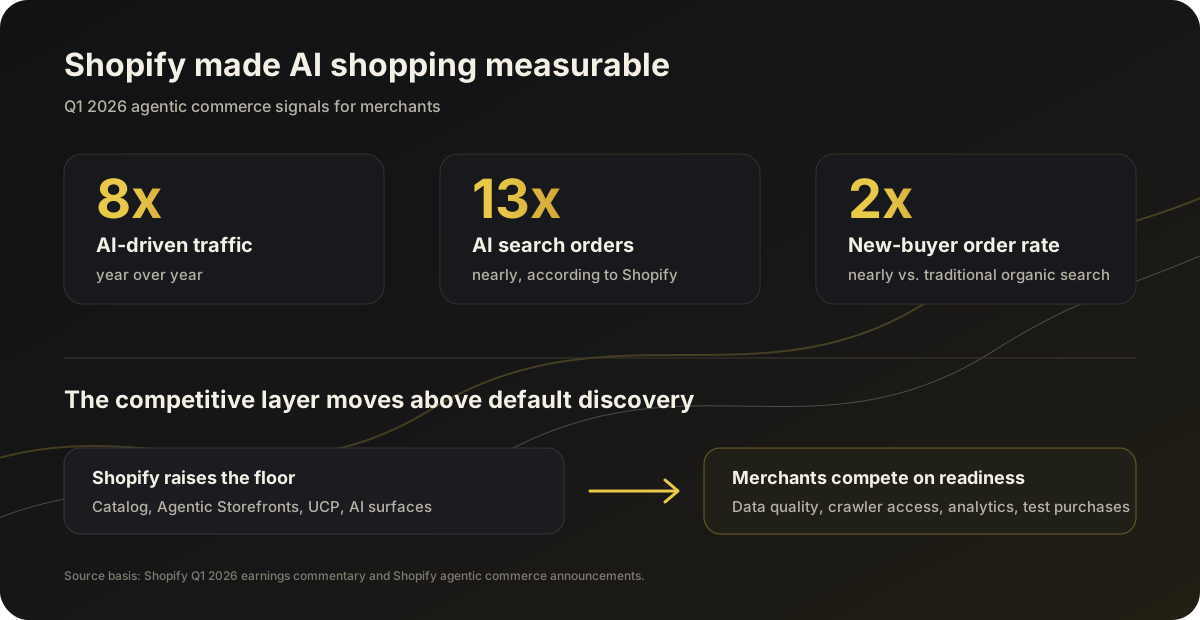
AI-driven traffic to Shopify stores grew 8x year over year. Orders from AI-powered searches increased nearly 13x. New buyer orders from AI searches are happening at nearly twice the rate of traditional organic search. That is not a product demo. That is channel performance. (The Motley Fool)
For Shopify merchants, the read is direct: Shopify agentic commerce is becoming measurable demand.
The financial context matters. Shopify is not making these claims in a weak quarter. In Q1 2026, Shopify merchants processed $100.743B in GMV, up 35% year over year. Shopify revenue was $3.170B, up 34%. Gross profit was $1.546B, up 32%. Free cash flow was $476M, with a 15% free cash flow margin. (GlobeNewswire)
The AI discussion is attached to operating performance, not speculative roadmap language. Shopify is talking about agentic commerce while the platform is compounding.
Merchant teams should start treating Shopify AI shopping as an acquisition channel with measurable demand behind it.
AI shopping is becoming an acquisition channel
The key number is not traffic alone.
Traffic can be noisy. AI crawlers can inflate logs. Chat referrals can show up in strange ways. Some AI visits are research, not purchase intent.
The stronger signal is orders.
Shopify said "orders from AI searches are up nearly 13x," and that new buyer orders from AI searches are occurring at "nearly twice the rate" of traditional organic search. (The Motley Fool)
Agents are finding products and sending buyers.
The practical shift is from indexing to assisted buying. A shopper asks a question. The agent compares options. The agent narrows the set. The agent sends the shopper into a buying flow.
Crawlability is no longer enough.
The old question was: "Can Google crawl this page?"
The new question is: "Can an AI agent understand this product well enough to recommend it, compare it, and route a buyer into checkout?"
Shopify is building the rails
Shopify's platform move is clear.
The company is building the infrastructure layer for agentic commerce: Shopify Catalog, Agentic Storefronts, Universal Commerce Protocol, and integrations across ChatGPT, Microsoft Copilot, Google AI Mode, and Gemini.
In January, Shopify announced UCP, co-developed with Google, describing it as "an open standard for AI agents." Shopify said UCP is designed to support native commerce at scale, including checkout flows with discounts, loyalty credentials, subscriptions, final sale terms, pre-order timing, and payment processor flexibility. Shopify also said UCP can work across REST, MCP, AP2, and A2A. (Shopify)
In March, Shopify made the merchant access story more concrete. Millions of merchants can sell to ChatGPT users through Agentic Storefronts. Products become discoverable in ChatGPT by default. Orders flow into Shopify Admin with ChatGPT referral attribution. Merchants remain merchant of record. (Shopify)
The baseline changed.
Shopify is raising the floor for millions of merchants. For many stores, the cold start problem gets easier. You do not need to build a custom ChatGPT integration from scratch. You do not need to create a separate AI channel feed for every surface. Shopify is making stores available to the places where AI-native product discovery is happening.
But "discoverable" and "optimized for agent conversion" are not the same thing.
Shopify gets your store in the room. You still have to compete inside the room.
Catalog is the structured product layer
The technical layer to watch is Catalog.
On the earnings call, Shopify said it has structured about 1 billion products with clean attributes, real-time pricing, and accurate inventory so AI agents can surface relevant products quickly. Shopify also said OpenAI and Microsoft are already using Shopify Catalog to power discovery. (The Motley Fool)
That explains why Shopify is pushing the Agentic plan beyond Shopify-native stores. Brands on other platforms can use Shopify Catalog to sell across AI channels without moving their main ecommerce store to Shopify. (Shopify)
Old AI shopping often relied on scraping.
Scraping is messy. It misses variants. It misreads availability. It can pull outdated pricing. It struggles with product nuance. It does not reliably understand which product is best for which buyer.
Structured product data is better.
For merchants, this means the quality of your product information becomes a growth lever. AI agents favor clean attributes, accurate inventory, real-time pricing, and product data that maps clearly to buyer intent. Shopify said the same in its March announcement: AI surfaces favor structured data with clean attributes and real-time accuracy. (Shopify)
Merchant-level competition starts there.
Shopify raised the floor. Merchants still compete above it.
Do not read this as: "Shopify solved agentic commerce, so we are done."
Read it as: "Shopify made AI discovery more accessible, so the competition moves to readiness."
When every Shopify merchant gets baseline access to AI channels, the advantage shifts to the stores that agents can understand best.
That includes the obvious pieces: product titles, descriptions, variants, images, pricing, inventory, return policies, shipping rules, and reviews.
It also includes the agent-specific layer:
- Rich product metadata and metafields
- Structured product data quality
- AI crawler access and robots.txt configuration
- llms.txt
- AGENTS.md or other agent instruction files where relevant
- WebMCP, MCP, or ACP compatibility beyond platform defaults where relevant
- Agent traffic analytics and attribution
- Real purchase testing across agent-assisted flows
- Cross-agent visibility across ChatGPT, Gemini, Copilot, Claude, Perplexity, and emerging shopping agents
The gaps show up in product detail.
An agent needs to know whether your "black everyday tote" is vegan leather, fits a 16-inch laptop, ships in two days, qualifies for free returns, and is better for commuters than travelers. It needs to know which variant is in stock. It needs to understand whether a discount applies. It needs to know whether checkout will work when the buyer arrives from an AI surface.
A human shopper might read around gaps.
An agent may not.
What "Shopify agent ready" should mean
Being Shopify agent ready does not mean installing one feature and moving on.
It means your store can be found, interpreted, compared, attributed, and tested in agent-driven buying flows.
Colter is built for that layer.
Colter is the independent QA layer for agentic commerce. Check scans a store across agent-readiness signals. Fix turns the scan into concrete remediation guidance. Lens tracks agent traffic, agent attribution, and readiness over time. Test runs AI mystery-shopper checks against real buying flows.
Shopify is not the problem.
Visibility is only the start. Merchants still need to see whether they are ready to win the demand that flows across Shopify's new floor.
Shopify's Q1 earnings made AI shopping a merchant KPI. Not because the language was ambitious, but because the numbers were measurable: 8x traffic growth, nearly 13x order growth, and new buyer orders happening at roughly twice the rate of traditional organic search. (The Motley Fool)
Start with a readiness check against the paths agents actually use.
Run a free agent readiness check at agenticcom.ai/check.